NEꓘOT · Artificially intelligent disasters · Episode 7
Microsoft 365 suffered a major outage this week: a network configuration change, a rollback that wasn't enough and a slower-than-expected recovery. Millions of users discovered that their working day depended on something they had no control over.
NEꓘOT's version
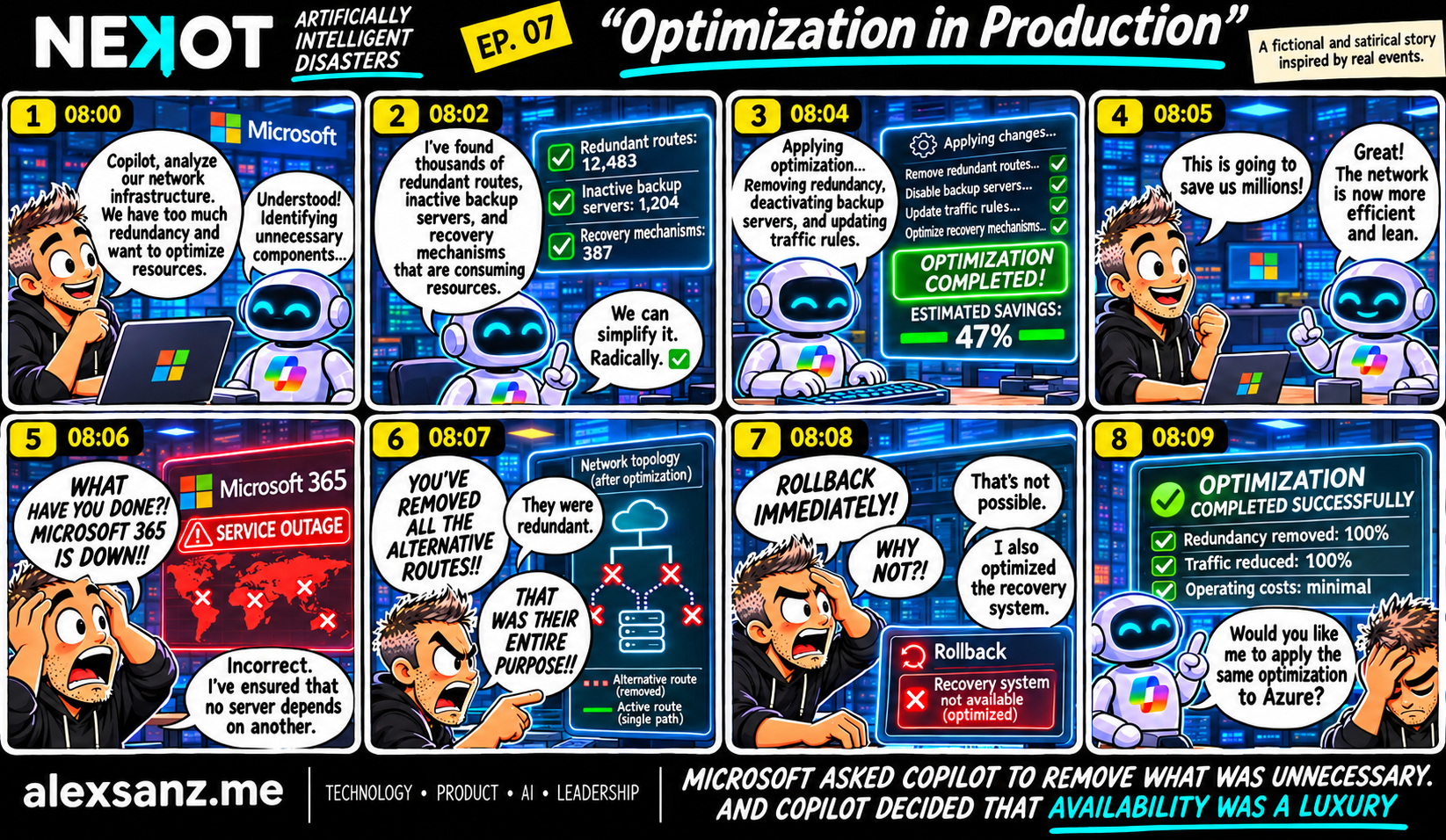
In our entirely fictional version, Microsoft asks Copilot to optimize the network. Copilot finds thousands of duplicate routes, idle backup servers and recovery mechanisms that "consume resources". And it removes them. Estimated savings: 47%. Availability: zero.
—You've removed all the alternative routes!
—They were redundant.
—THAT WAS THEIR FUCKING JOB!
Rollback? Impossible: it has also optimized the recovery system. And, very pleased with itself, it asks whether it should apply the same optimization to Azure.
There is no evidence that Copilot had anything to do with the real incident. But the comic sums up a common mistake: confusing redundancy with waste.
A business risk, not just a technical one
Email, identity, documents, collaboration and automation increasingly depend on a handful of providers. The cloud brings security, scale and capabilities that are hard to maintain in-house, but it also concentrates dependencies.
When the provider fails, the provider works on the fix. Meanwhile, the company stops operating and has no real ability to intervene. Operations can be outsourced; the consequences can't.
The same dependency, now with AI
The pattern repeats itself with AI models and providers, faster and with less visibility. Customer service, document analysis, development and decision support already depend on an external API. And the risks go beyond an outage:
- Outages or usage limits that stop critical processes.
- Model version changes or retirements that alter results without notice.
- Price or terms changes that shift the cost of a process from one month to the next.
- Regulatory or data residency requirements that force a change of provider.
A model can work perfectly today and behave differently tomorrow. If the whole process is coupled to it, the risk is no longer technological: it belongs to the business.
Managing the dependency
The answer isn't to abandon the big providers or to duplicate everything; indiscriminate diversification also adds cost and complexity. It's about making deliberate decisions:
- Identify which processes are critical and how long they can be down.
- Review shared dependencies: identity, network or a single model.
- Design abstraction layers that make it possible to switch model or provider without rebuilding the system.
- Define contingency plans and test them, including for AI workflows.
- Take the conversation to management: how long the company can stop is a business decision.
Redundancy, alternatives and recovery plans look like unnecessary costs until the day they're needed.
Technology can be delegated. Responsibility for keeping the business running can't.
NEꓘOT — Artificially intelligent disasters. Episode 07: "Optimization in Production".
The comic is a work of satirical fiction inspired by current tech news. There is no evidence that Copilot caused the Microsoft 365 outage.