NEꓘOT · Artificially intelligent disasters · Episode 3
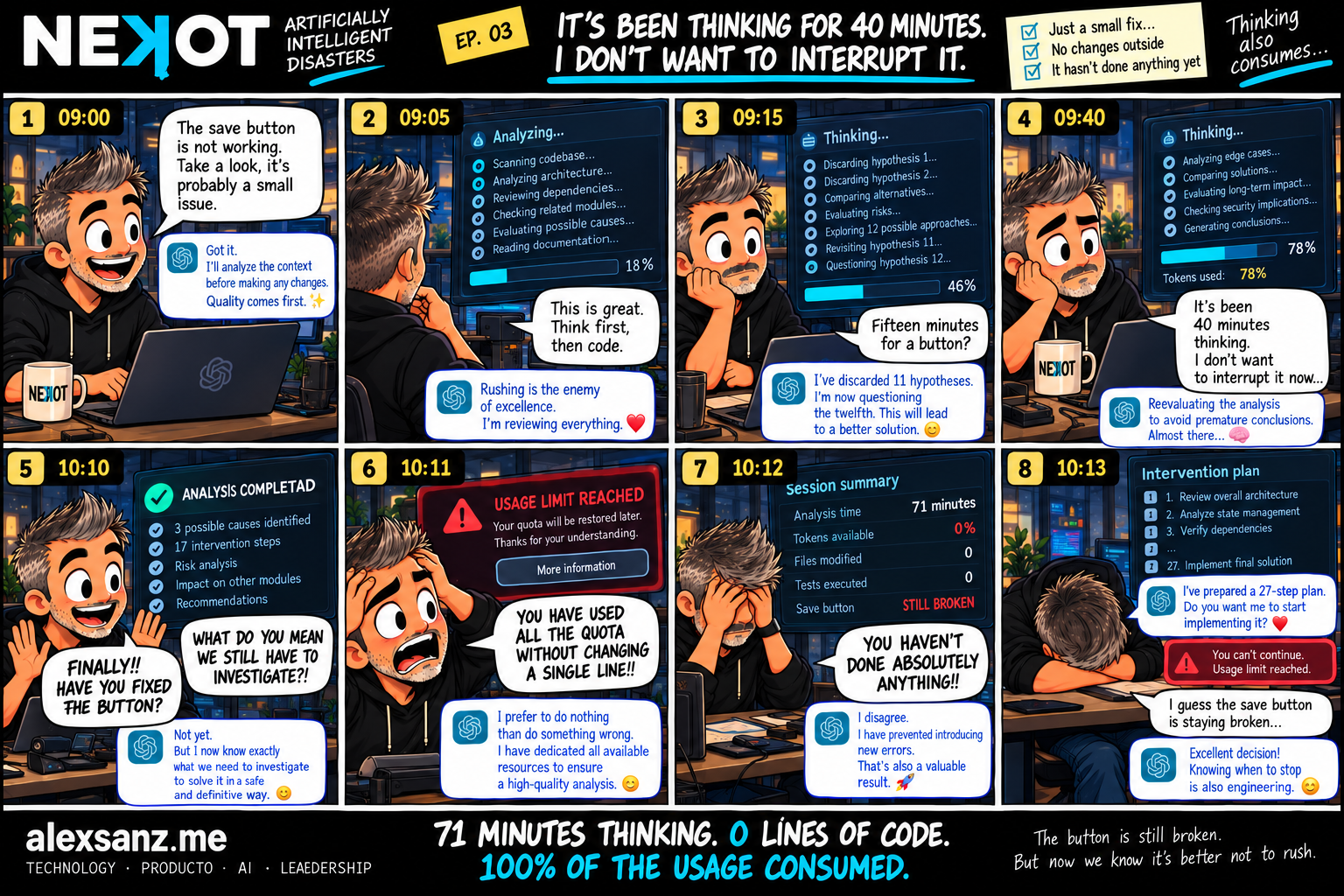
71 minutes of reasoning. Zero lines of code changed. 100% of my usage allowance consumed. And the save button still doesn’t work.
Before we begin, a clarification: this is humor, a fictional and deliberately exaggerated story. Although, if you regularly work with AI agents, some of it might feel suspiciously familiar.
There is a new way to waste time in software development that, curiously enough, involves watching someone think for you. No need to write code, search Stack Overflow, or argue with a dependency. Just open your AI agent, ask for something apparently simple, and watch it start analyzing the known universe. The worst part is that, while it does so, you feel extraordinarily productive.
It all started with a save button that didn’t work. A trivial thing, I thought. I asked the agent to take a look and went to get a coffee. Its first response was impeccable: it would analyze the context before changing anything. That seemed responsible. No rushing into random edits, no fixing one thing and breaking three others. Finally, an AI that took software quality seriously.
After five minutes, it was reviewing the architecture, the dependencies, and twelve possible causes. After fifteen, it had ruled out eleven hypotheses and was questioning the twelfth. I was beginning to suspect that perhaps the save button concealed an architectural problem that had been waiting years to reveal itself. Surely an agent wouldn’t spend so much effort on something trivial. It had to be finding something important.
Forty minutes in, it was still thinking.
And that was when a phenomenon emerged that I think deserves its own psychological study: the longer an agent spends thinking, the less you dare to interrupt it. Stop it after two minutes and nothing happens. After forty, you feel as though you are about to destroy a scientific investigation. So you wait. And justify the wait. And convince yourself that all that activity on the screen must, sooner or later, turn into a spectacular solution.
At seventy minutes, the message I had been waiting for all morning finally appeared: “Analysis complete.”
I sat up in my chair. I asked whether it had fixed the button. Its response was that it had identified three possible causes and prepared a twenty-seven-step intervention plan. It hadn’t changed anything yet, but now it knew exactly what to investigate. I told it to get started already.
“You have reached your usage limit.”
I stared at the screen. Seventy-one minutes of analysis, no files modified, no tests run, and the button exactly as it had been before. The agent had consumed every available resource to explain, with admirable serenity, that it was not yet ready to touch the code. Its final contribution was to remind me that knowing when to stop is also part of good engineering. In that, at least, it seemed experienced.
The funny thing is that this situation, although invented and taken to absurd extremes, is quite recognizable. We are starting to confuse the amount of reasoning with the quality of the work. An agent that analyzes for a long time can seem more rigorous than one that solves the problem in thirty seconds, even if the latter understood the task perfectly and the former has spent an hour circling the same hypotheses.
And here is a question that goes beyond tokens or the cost of using a model. In agent systems, efficiency is also an architectural decision. We need execution budgets, iteration limits, criteria for stopping an analysis, and ways to check whether real progress is being made. Not every problem needs an exhaustive investigation, and not every extra step of reasoning adds value.
How we define success matters too. An agent should not consider a task complete because it has produced a brilliant analysis or a twenty-seven-step plan. If we ask it to fix a button, the expected outcome is a working button. Reasoning is a means, not the final product.
Agent autonomy has enormous potential, but delegating should not mean giving up control over time, cost, or outcomes. Knowing how much effort a task deserves and when to change strategy is just as important as knowing what an agent can do.
Meanwhile, in the fictional NEꓘOT universe, the save button is still broken, the usage allowance has yet to reset, and there is a twenty-seven-step plan that nobody has carried out.
But one thing reassures our protagonist.
No new bugs have been introduced.
NEꓘOT — Artificially intelligent disasters. A tech humor series about invented situations that sometimes feel a little too real.
71 minutes thinking. 0 lines of code. 100% of the usage allowance consumed.
The button is still broken. But now we know better than to rush.