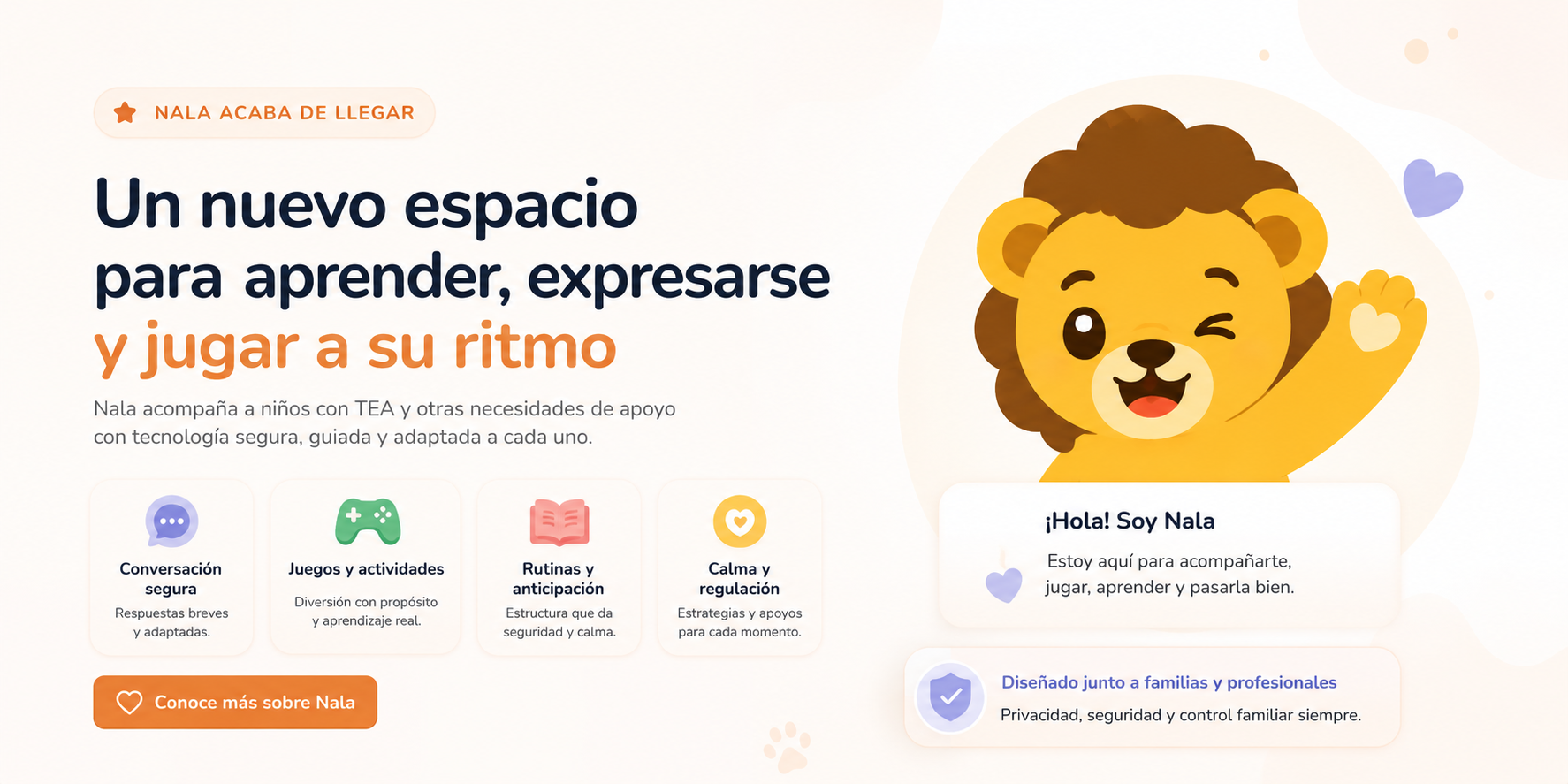
In a world where many digital tools compete for more and more attention, Nala was created with a different intention: to offer a calm, guided, and safe space for children who need an experience that feels clearer, more structured, and more human.
Nala, short for Natural Adaptive Language Assistant, captures its purpose quite well: a language assistant designed to adapt to each child in a natural way, with structure, calm, and guidance.
Nala is designed especially for children with ASD, although it can also be valuable for children who need support with communication, learning, or emotional regulation. It is not presented as a clinical application or as a simple digital game. Its value sits in a very specific place: bringing together guidance, structured learning, and conversational technology in an experience that children enjoy and families understand.
This is not only about answering. It is about supporting children well.
What is Nala?
Nala is a guided conversational environment where each child has their own space.
This is not an open, unpredictable, context-free chat. Nala offers an experience adapted to each child's profile: with an adjusted tone, short responses, specific interests, visible games, calming supports, and limits defined by the family.
The idea is simple, but powerful: a child can talk, play, ask questions, follow a routine, or slow things down in the same environment, without overload, without excessive stimulation, and without losing safety.
Nala helps make technology easier to understand, more predictable, and more useful in everyday life.
Why is something like this needed?
Many digital tools work well for neurotypical children, but they are not always designed for how many children with ASD learn, process information, or communicate.
They are often too fast, too ambiguous, or too open-ended. That can create more noise, more cognitive load, and less clarity.
Nala starts from the opposite approach:
- less friction, more structure
- less unnecessary stimulation, more intention
- less improvisation, more guidance
Its design is inspired by principles that many families and professionals already know:
- structured teaching inspired by TEACCH
- communication and language supports aligned with AAC
- a focus on social communication and emotional regulation, in line with frameworks such as SCERTS
- play-based learning as a natural way to practice, stay motivated, and participate
Nala does not diagnose, assess, or replace therapy or professional educational support. It is a day-to-day support tool, designed to translate some of those principles into a simple, friendly, and consistent digital experience.
What can a child do inside Nala?
Nala does not force a single way of using it. It can support different moments and needs:
- free conversation
- guided play
- shared stories
- calm moments
- visual routines
- adapted questions and answers
- writing and comprehension activities
Children can interact with Nala according to their pace, their interests, and their emotional state in that moment.
The product also includes concrete experiences such as Mystery Gift, The Wheel of Fortune, and Write with Nala, designed to work on vocabulary, comprehension, attention, turn-taking, anticipation, or writing without turning the experience into a rigid lesson.
That nuance matters: Nala is not trying to examine the child. It is trying to help them participate.
A useful tool for families too
For a children's tool to work, families need to understand it and trust it.
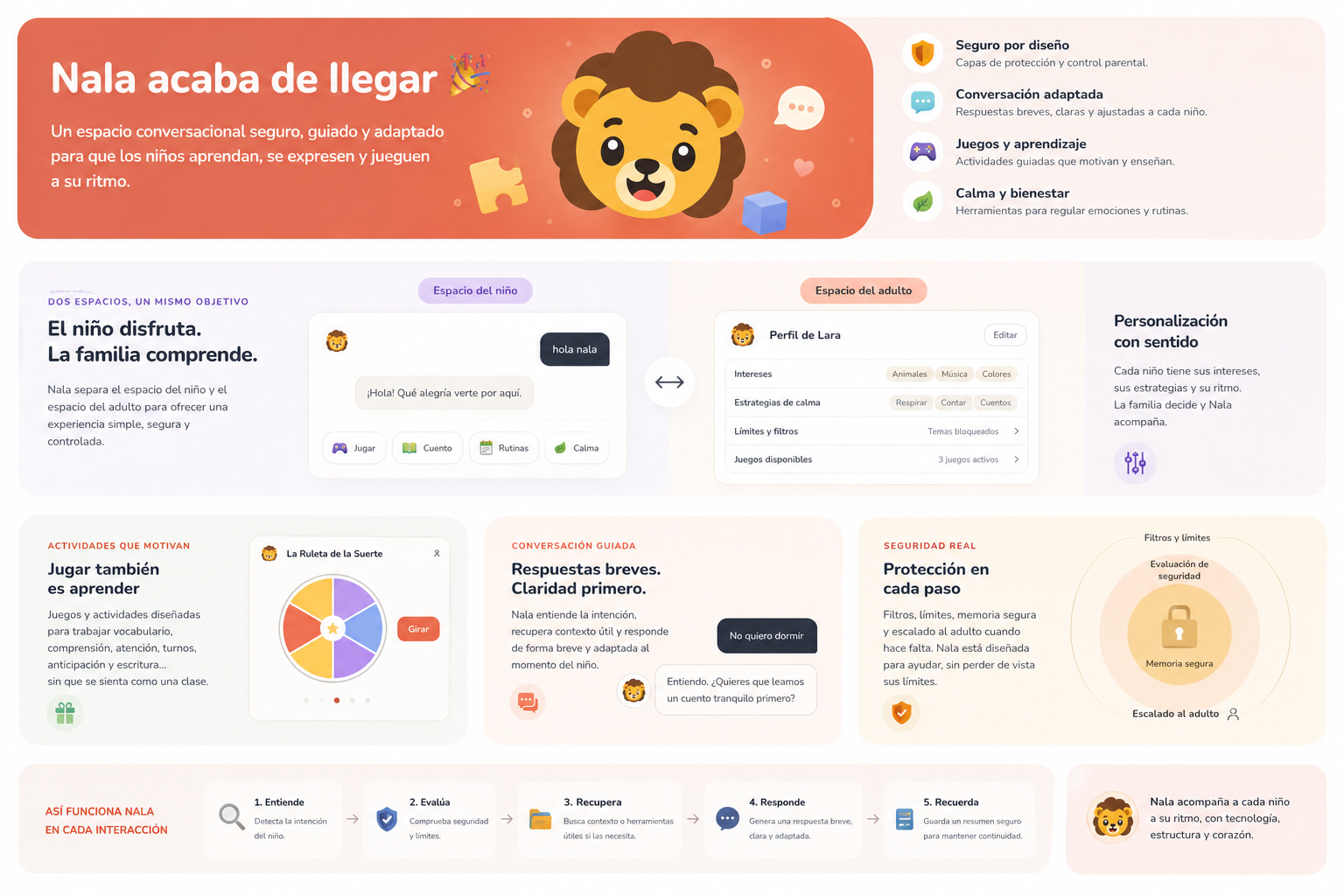
That is why Nala clearly separates two spaces:
- the child's space, simple, calm, and adapted
- the adult's space, where context, interests, limits, visible games, and the type of guidance are configured
This separation makes something essential possible: the child gets a smooth and natural experience while the family keeps control and understanding of what is happening.
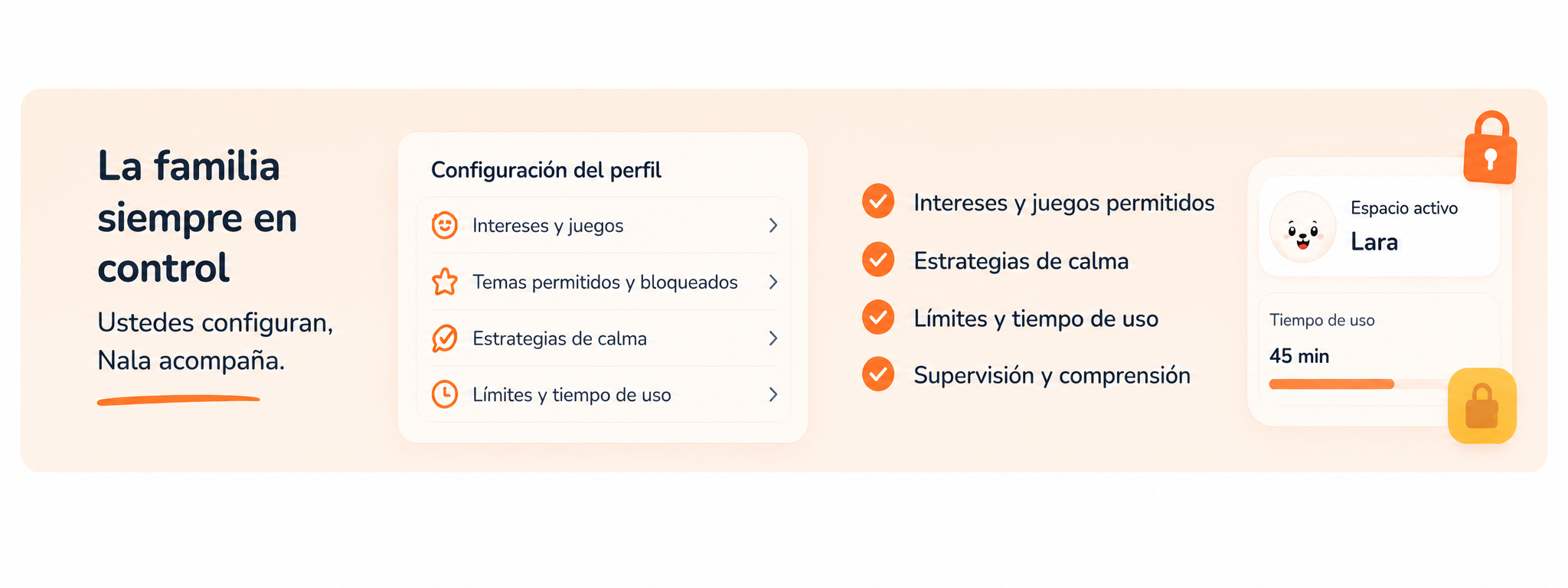
Families can decide which topics to avoid, what kind of response is most appropriate, which games are available, and which calming strategies can best help each child.
Personalization that makes sense
One of the most common mistakes in children's products is treating every child the same way.
Nala does the opposite.
Each profile can be configured with:
- specific interests
- calming strategies
- adapted response length
- enabled or disabled games
- an adjusted conversational tone
- limits defined by the family
This personalization is not meant to make the experience more decorative. It is meant to make it more useful.
Because not every child needs the same pace, the same words, the same supports, or the same kind of interaction.
An experience designed for real moments
Nala can help in everyday situations such as getting ready for a routine, practicing a sentence, asking for help, expressing how a child feels, waiting for a turn, playing with simple rules, or slowing down after an intense moment.
For example, if a child says "I don't want to sleep," Nala does not have to respond in a generic way. It can offer a short routine, a calm story, an anticipation phrase, or a calming strategy depending on the profile configured by the family.
That is where Nala's value lies: it does not only converse, it supports from context.
A product that brings together three dimensions
What is interesting about Nala is that it combines three worlds that usually appear separately:
- a friendly and understandable experience for families
- an educational and explanatory logic that is easy to understand
- a guided environment that supports children without overload
It is not trying to look like therapy.
It is not trying to be only a game.
It is not trying to behave like an open chatbot.
The technical side that makes all this possible deserves its own explanation. But in this article, what matters most is something else: the final experience for the child and real peace of mind for the family.
Nala is trying to be something more valuable: a digital space where learning, self-expression, and play make sense for the child and bring peace of mind to the adult.
In summary
Nala is a technological proposal designed for children with ASD and other support needs, built with a clear ambition: to show that child-focused AI can be useful, understandable, and safe at the same time.
A place where the child can talk, play, practice, regulate themselves, and move forward at their own pace.
An environment where the family understands, configures, and supports.
A technology that is not trying to capture more attention, but to offer better support.
Nala: learn, express yourself, and play at your own pace.